Year of Mazda MX-6
Mazda''s midsized, 4 cylinder sport coupe. Although Mazda is a Japanese owned company, it produces the MX-6 in the United States at the Flat Rock, Michigan plant. The Ford Probe is built on the same platform as the MX-6, and is very similar in many aspects.
Mazda MX-6 photos, specs - Car Pictures & Images
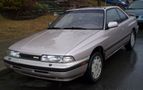 The Mazda MX-6 was a front-wheel drive sporty coupé produced by Mazda between 1987 and 1997. It was called the Mazda Capella in Japan until 2002 before being renamed Mazda Atenza/ Mazda6. The MX-6 was mechanically identical to the Mazda 626 and subsequently the Ford Probe. These cars shared the GD (1988-1992) and GE (1993-1997) platforms. The MX-6 replaced the 626 Coupé, although it continued to share the same chassis. Mazda shared the GD and GE chassis with Ford for their own Probe. The MX-6, 626 and Ford Probe were made together in joint-venture plants either by AutoAlliance in Flat Rock, MI for the North American market, and by Mazda Japan for Asian and European Markets. |
Used Mazda MX-6


The first generation MX-6 appeared in 1988 and lasted until 1992 in the United States. In some markets the model years were from 1987 to 1991. It was based on a series of futuristic sports compact concept cars of the early 1980s. It was a large coupé, based on the Mazda GD platform, and was powered by the I4 Mazda F engines. The US market made use of the F2 2.2L engine, with the base engine produced 110hp (82kW), but a 145hp (108kW) turbocharged version was available. European and Japanese market versions were shipped with either the F8 1.8L, FE 2.0L or FE-DOHC 2.0L DOHC engines. The MX-6 was produced with two transmission options, a 5-speed manual transmission or a 4-speed automatic with overdrive. The MX-6 was also known to be a very reliable car, mechanically. This generation was available in several trim levels, which differ depending on the market the vehicle was sold in. In the United States, the MX-6 was available in DX, LX, LE, and GT trim levels:
In 1989, Mazda offered a special four wheel steering (commonly abbrieviated 4WS) option on MX-6 GTs destined for the U.S. This system consisted of an electronically controlled rear steering rack that turned the rear wheels opposite to the fronts at low speeds to improve cornering, and turned the rear wheels with the fronts at high speeds to improve highway lane change maneuvering. This option was available through all years for GT models in other markets. » Read More About Mazda MX-6 |
Mazda MX-6 Pictures by Years


