Year of Volkswagen LT 28
Volkswagen LT 28 photos, specs - Car Pictures & Images
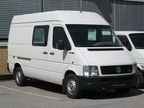 The Volkswagen LT was the largest panel van produced by Volkswagen (and consequently Volkswagen Commercial Vehicles as of 1996) from 1975 to 2006. Two generations were produced. Conception historyAs early as the Spring of 1950, Volkswagen had exerted a decisive influence on the market for light commercial vehicles in Germany and Europe, with the renowned Volkswagen Type 2. The name ‘Transporter' (the name under which the Type 2 was sold in Brazil) rapidly established itself as a concept term to describe an entire commercial vehicle segment. Through the continuous development of the Type 2, above all after the introduction of the revised Volkswagen Type 2#T2 in 1968, additional demand was shown, especially from commercial customers. Increasingly heavier and larger-volume freight items required transportation using compact commercial vehicles. This saw the classic Type 2 reaching the limits of what was possible, in part conditioned by the rear mounted engine design. |
DesignThe set of specifications for the new larger transporter, as an additional series, were very clear in requiring as much utility space as possible in a small footprint. The planned tonnage classes; from 2.8 tons gross vehicle weight upwards to 3.5 tons, called for a strong traction rear drive, and ruled out a rear engine placement in accordance with the original spacial requirements. As a result, the engine was located above the front axle, between the driver and passenger seat. LaunchThe new VW van celebrated its launch in 1975 in Berlin. The name given to Volkswagen's large transporter was as functional as the entire vehicle: it was just called LT, which is simply the abbreviation of Lasten-Transporter (‘cargo transporter'). RangeThe LT came in three gross vehicle weights, from 2.8 to 3.5 tons (LT 28, LT 31, LT 35), with two wheelbases, two roof options, and with bodywork options as a panel van, a compact, a platform vehicle and a chassis/ cab combination. The ratio of utility space to footprint was nothing short of sensational: Thanks to the cab-over-engine construction and the overall width of 2.02 meters, even the compact LT panel van (with the short wheelbase and little over four and a half meters in length) offered a load length of over three meters and a load area of around 5.5 square meters. Even at that time, Volkswagen's transporter developers placed great value on secure and comfortable handling. For that reason, the LT was equipped with a front axle with independent front wheel suspension, which at that time and in later years, was not standard in this class of vehicle. Later options, such as the heavy LT 40 to LT 55, had a rigid front axle for reasons relating to load-carrying capacity; this is remains common procedure today on more modern light trucks. Engine upgradesIn time, problems were presented by the choice of engine for the original LT, and Volkswagen's own stocks offered only the familiar air-cooled boxer engines for rear mounting. The dimensions of the new generation of engines for the Volkswagen Golf, which was launched at practically the same time, were too small, as was the power unit on the still youthful mid-class Volkswagen Passat sedan. » Read More About Volkswagen LT 28 |
Volkswagen LT 28 Pictures by Years


