2007 Land Rover Defender


Photo #1
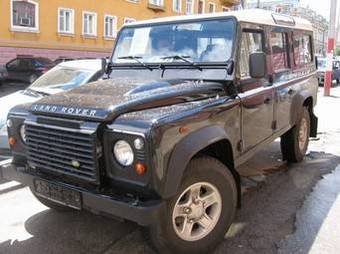
Photo Information (Width: 340px, Height: 254px, Size: 17Kb)
| Engine size - Displacement - Engine capacity: | 3500 cm3 |
| Transmission Gearbox - Number of speeds: | Manual |
| Fuel Type: | Diesel |
| Drive wheels - Traction - Drivetrain: | 4WD |
| Price (out of date): | $37648 |
2007 Land Rover Defender specs, Engine size 3500cm3, Fuel type Diesel, Drive wheels 4WD, Transmission Gearbox Manual
|
Used Land Rover Defender


The Defender was not an entirely new model at launch. It used engines and body panels carried over from the Series III Land Rover; gearbox, axles and suspension from the Range Rover. Production of the model now known as the Defender began in 1983 as the Land Rover One Ten, a simple name which reflected the 110 inch (2.794 m) length of the wheelbase. The Land Rover Ninety, with 93inch (2.362m) wheelbase, and Land Rover 127, with 127in (3.226m) wheelbase, soon followed. Outwardly, there is little to distinguish the post-1983 vehicles from the Series III Land Rover. A full-length bonnet, revised grille, plus the fitting of wheel arch extensions to cover wider-track axles are the most noticeable changes. Mechanically the Ninety and One Ten were a complete modernisation of the former Series platform. Specifically:
The One Ten was launched in 1983, and the Ninety followed in 1984. From 1984, wind-up windows were fitted (Series models and very early One Tens had sliding panels), and a 2.5-litre, 68hp (51kW) diesel engine was introduced. This was based on the earlier 2.3-litre engine, but had a more modern fuel-injection system as well as increased capacity. A low compression version of the 3.5-litre V8 Range Rover engine was available too which transformed performance. » Read More About Land Rover Defender |