The History Of Nissan Cefiro Wagon

The Nissan Cefiro was an intermediate-size automobile range sold in Japan and other countries. It was introduced initially as a 4 door sedan, however a wagon was later produced. A large proportion were equipped with automatic transmissions.
Originally marketed towards the Japanese salaryman, the top model used the same engine as found in the R32 Nissan Skyline, a 2 litre turbo charged 6 cylinder engine capable of just over 200 hp (150 kW). Other variants came with other versions of the Nissan RB engine. Brand new, the Cefiro was slightly more expensive than the equivalent Nissan Skyline.
The model years of second and third generation Cefiros in Japan differ from those in the United States. The Cefiro was also a grey import that was popular in the United Kingdom, Ireland, New Zealand and Russia. With each incarnation, the Cefiro was marketed more toward the executive segment, losing some of its sporty zeal.
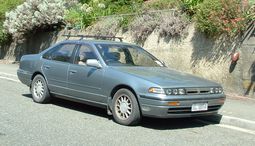
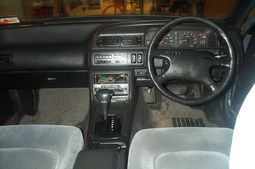
Released in September 1988 to the Japanese Domestic Market, it ceased production in May 1994. The A31 series included many hi-tech features, such as HICAS 4-wheel steering, sonar-controlled electronic damping, automatic headlights, and an automatic electric rear view mirror, many of which were seen later on the R32 Nissan Skyline, released one year later in 1989.
The A31 Cefiro was similar to the Nissan Laurel. The Cefiro is something like a luxury Nissan Skyline although these two were produced at the same time as the Cefiro. Mechanically, it was closest to the Nissan Skyline and Nissan Laurel, as they all had the same floorpan; but it shares its MacPherson strut front suspension with the S13 Silvia with the exception of the 4WD version which shares the same front and rear suspension as the GT-R and GTS4 Skyline.
The A31 Cefiro featured several versions of the RB-series straight-6 engines including the intercooled turbo RB20DET, although it was slightly detuned in the Cefiro. It also was not fitted with a re-circulating blowoff valve like the RB20DET powered Nissan Skyline.
It was also, together with the Nissan Skyline, one of the first Japanese cars to have a 5-speed automatic transmission in the 2.5 litre and the very last of the 2 litre models. All 2 litre turbo versions with automatic transmissions used a 4-speed transmission.
Unlike many new car designs at the time, the A31 Cefiro was rear wheel drive, with all-wheel drive models being available as well. Unlike the future versions of the Nissan Laurels and Nissan Skylines, the Cefiro would become a front wheel drive in all models following the A31 Cefiro.
At the beginning of its production it was mostly overlooked as just an ordinary family sedan compared to the Nissan Skyline but in later times it has become very popular in the drifting scene. Spurred by the relatively cheap price of the car compared to other drifting vehicles in Japan, some enthusiasts bought the Cefiro for use in drifting. As a result this car has gained cult status in Japan, New Zealand, Thailand, Malaysia and Australia as a drift car due to the interchangeability of parts with other performance models and highly tunable nature of the chassis design. It is also a relatively cheap car outside Japan as it is exported second hand.
This chassis was also the basis for the S13 chassis in the Nissan Silvia.
General specifications
Body type: Sedan
Drive: FR and AWD
Displacement: 1998cc N/ A and turbo, 2498cc N/ A
Engine Specs
Engine model: RB20E, RB20DE, RB25DE, RB20DET
Max.power: 205 PS (151 kW) / 6400 rpm RB20DET
Max.power: 190 PS (138 kW) / 6400 rpm RB25DE
Max.power: 155 PS (114 kW) / 6400 rpm RB20DE
Max.power: 125 PS (91.94 kW) / 5600 rpm RB20E
Turbo Information: Ceramic
Fuel system: NISSAN EGI (ECCS) (electronic gasoline injection) electrically controlled gasoline injection
Turbocharger: Intercooled turbo
Fuel type: Unleaded premium gasoline
Exterior specifications
Exterior dimensions (LxWxH): 4690 x 1695 x 1375 mm Interior dimensions (LxWxH): 1910 x 1425 x 1140 mm Wheel base: 2670 mm Ground clearance: 150 mm Curb vehicle weight: 1350 kg (auto turbo) 1330 kg (manual turbo) 1260 kg (manual RB20E) 1280 kg (auto RB20E) 1300 kg (RB20DE manual) 1320 kg (RB20DE auto), 1400kg (auto turbo 4wd) Seating capacity: 5 Doors number: 4 Min. turning radius: 5 m Fuel tank capacity: 6
Suspension specifications
Power steering: Yes
Suspension system: front Independent suspension strut type
Suspension system: rear Independent suspension multiple link type
There are also many "sub models" which are the same as the above listed but feature HICAS 4 wheel steering as well. Nissan took the unusual step of making a left hand drive version of the Cefiro. Unlike all the Japanese versions it was fitted with a carburetted RB24 which was a single cam 6 cylinder 2.4L RB series motor.
Later models were given a softer look with revised light and bumper/ grill design as well as "interior softening". These are referred to as the "facelift" shape and appear a little more refined in appearance.
Modifications
The most common engine modification is the RB25DET engine swap, which gives the car higher torque than the RB20DET engine, suited better for drifting. Others have successfully swapped an RB26DETT engine (as used in the Skyline GT-R R32-R34) with some minor oil sump modifications, along with an RB25DET gearbox. Some tuners prefer to use the lighter and more compact SR20DET using the RB25DET gearbox. Also many of the Silvia (S13), Laurel (C33) and Skyline (R32) parts are interchangeable, which gives flexibility in choosing parts.
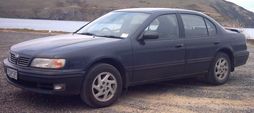
With the debut of the A32, Nissan changed the market orientation of the Cefiro from a premium sports saloon (A31) to an executive saloon with the advent of the A32 series. Generally the A32 was only badged as the Cefiro in Japan for the domestic market, A32's that were exported new from Japan usually wore the Maxima badge.
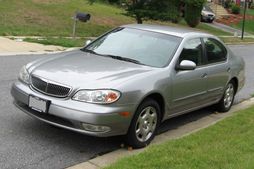
This particular series was softened considerably, lacking the sporting edge of the A31. It was equipped with the award-winning VQ series V6 engines. The A32 is the same chassis that forms the basis to the Infiniti I30 (which is near identical to the A32 Cefiro Brougham VIP model), as well as being rebadged as the Nissan Maxima QX for some other markets including the European, with three versions of the VQ, the VQ20/ 25/ 30DE, see Nissan VQ engine.
However in the U.S., the Maxima GXE and SE were closer to the Cefiro Excimo and S-Touring editions than were their Infiniti I30 counterparts.
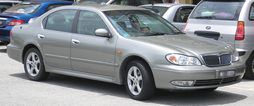
Sharing the A33 platform with Maxima and Infiniti I-series, the last true Cefiro was bigger. Like the A32, the newer A33 was designed more towards executive while retaining some of its sporty zeal. Available engines were VQ20/ 25/ 30DE-K/ VQ35DE and some Neo and direct injection engines were available as well. Trim levels are 2.0 and 2.5 Excimo, 2.0 and 2.5 Excimo G, 2.0 and 2.5 S Touring, and 3.0 Brougham VIP. 5 speed manual transmission is only for 2.0 Excimo and 2.0 S Touring.
The limited edition L Selection and modified Autech version were also offered in Japan.
In Australia, the A33 was called Nissan Maxima and sold from 1999 to 2002. Trim levels are S, ST, and Ti. All models were powered by 3.0 liter engine.
The A33 is still in production for the Malaysian market, as the 3.0 Brougham VIP and Excimo 2.0G.
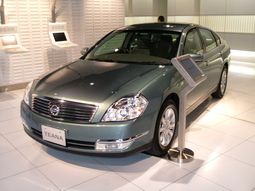
Main article: Nissan TeanaThe Cefiro disappeared in 2003, but the name continues to be used in some export markets, using the Nissan Teana J31 as a new replacement model.
The J31 Teana was sold under the name of Teana in Japan, Thailand, Philippines, Taiwan & China. The same car is sold under the name of Cefiro in Hong Kong, Singapore, Brunei, Latin America & Caribbean and Maxima in Australia & New Zealand.
From Wikipedia, the free encyclopedia
More About Nissan Cefiro Wagon


|