Year of Toyota Estima
Toyota Estima photos, specs - Car Pictures & Images
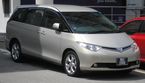 The Toyota Previa, also known as the Toyota Estima (エスティマ) in Japan and the Toyota Tarago in Australia, is an MPV or multi-purpose vehicle (known as a minivan in North America) produced by Toyota Motor Corporation since 1990. The first generation, introduced in 1990, had only one sliding side door for the rear passengers. It featured a unique mid-engined platform, where the in-line 4-cylinder gasoline-powered engine was installed almost flat (at a 75-degree angle), beneath the front seats. Installing the engine in this configuration allowed easy access to the spark plugs, which were located underneath a panel on the upper right-side of the vehicle, after tilting the front seat backward. All engine-driven accessories, such as the alternator, power steering pump, air conditioning compressor, and radiator fan, are accessible from the front hood, driven off the front of the engine by an accessory driveshaft, and is known as the Supplemental Accessory Drive System, or "SADS." This allows for even front/ rear weight distribution, which benefits ride quality and handling. However, it also prevents the installation of a larger engine, while the cost could not be relayed by sharing the platform with other vehicles.[citation needed] |
Used Toyota Estima


The first generation Previa was 4750mm (187in) long and 1803mm (71in) wide. In Japan, two smaller versions, the Toyota Estima Lucida and Toyota Estima Emina, were produced, which were approximately 110mm (4.3in) narrower and 70mm (2.8in) shorter than the standard model. The reason for the difference between the smaller Emina and Lucida models is the vehicle tax system in Japan, which is based on the product of length and width of the car. The smaller variants fall in to a lower tax band. The Estima Emina and Estima Lucida were also available with a 2.2 litre diesel engine (3C-T and 3C-TE). The first generation Previa was available in both rear- and all-wheel drive versions (called All-Trac) and powered by a 135 hp JIS (99 kW) 4-cylinder 2.4-litre fuel injection engine. Available with a 4-speed automatic or 5-speed manual gearbox, this Previa also seated seven or eight people, with three seating configurations offered (North America only received the seven passenger configurations, however). All configurations have a driver and front passenger seat forward, and a three-seat bench seat at the rear that splits and folds flat against the sides of the cabin. The 8-seat configuration contains a 2/ 1 split swiveling bench seat in the middle row, while the 7-seat configurations contain either two independently swiveling captain's chairs (referred to as "Quad Seating"), in the middle row or a two seat bench offset towards the driver's side. The third row is also better upholstered in the 7-seat version. It was available with either 4-wheel disc brakes or traditional front disc/ rear drum brake setup, with Anti-Lock Brakes (ABS) as an option. United StatesIn the United States, the Previa was sold from 1991 through 1997. It was imported from Japan to compete with Chrysler Corporation's successful Dodge Caravan minivan, and its twins Chrysler Town and Country and Plymouth Voyager. The Previa quickly became a common vehicle in the US, despite its relatively high price, poor fuel economy, and single sliding door (the Chrysler minivans offered dual sliding doors, beginning with their 1996 redesign). The mid-engine design proved to have a special weakness - the inability to increase engine size, which proved a significant problem as American drivers were used to having more power; the Dodge/ Plymouth/ Chrysler models were sold with available V6 engines. Starting in 1994, Toyota solved this problem by offering a twin-screw Roots-type supercharger with air-to-air intercooler, providing 6psi of boost (these models were called the "S/ C"), bringing the engine power up to a competitive 160 hp (119 kW). Initially, the S/ C engine was only available as an option on the LE in 1994. For 1995, the normally-aspirated engine was discontinued, and the S/ C became the standard engine on all trim levels. The United States version of the Previa was discontinued after the 1997 model year, replaced by the more traditionally-designed, front-wheel-drive, U.S.-designed and -built, Camry-based Sienna. A few Americans have obtained the newer Previa model (and first generation Japan-spec Estimas),[citation needed] but the U.S. DOT and EPA restrictions against "grey-market" import vehicles are very strong. » Read More About Toyota Estima |
Toyota Estima Pictures by Years


