Year of Toyota Corolla Levin
Toyota Corolla Levin photos, specs - Car Pictures & Images
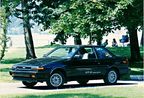 The AE86 generation of the Toyota Corolla Levin and Toyota Sprinter Trueno is a small, lightweight coupe introduced by Toyota in 1983 as part of the fifth generation Toyota Corolla line-up. For the purpose of brevity, the insider-chassis code of "AE86" is used to describe the whole range. In classic Toyota code, the "A" represents the engine that came in the car (the 3A and 4A) and the E86 represents the 6th revision of the fifth generation (E80 series) of the E model which is the Corolla. The visual difference between the Levin and Trueno is that the former has fixed-headlights and the latter has retractable headlights. The export model name Corolla covers both variations. The AE86 (along with the lower spec 1,452cubic centimetres (1.452L) AE85 and 1587cc SR5 versions) was rear wheel drive (unlike the front wheel drive CE80, EE80 and AE82 models), and is among the last rear-drive cars of its type, at a time when most passenger cars were being switched to front-drive. The AE86 was replaced in 1987 by the front wheel drive AE92 Corolla/ Sprinter range. The AE86 was also known as the Hachi-Roku (ハチロク, Hachi-Roku?) (after the numbers eight (ハチ, hachi?) and six (ロク, roku?) in Japanese).[citation needed] |
Used Toyota Corolla Levin


The AE86 was available with a fuel-injected 4-cylinder twin-cam 1587cc 4A-GE engine in Japan and Europe which was also used in the first-generation Toyota MR2 (AW11). This engine had a maximum power output of 130 PS (97kW) and 103ft·lbf (140nm) of torque in standard form. The AE86 came with a 5-speed manual gearbox, and later came with the option of an automatic. The 4A-GE engines used in the AE86 and AW11 were equipped with T-VIS (Toyota Variable Intake System). The AE86 had an optional Limited Slip Differential (LSD). In North America, a modified 4A-GEC engine was used to comply with California emissions regulations. Power was rated at 112bhp (84kW), and 100ft·lbf (136nm) of torque. It should be noted however that the cost of these emission regulations in a tendency to burn oil, especially when dealing with a older vehicle that has had 2 or more owners. The AE86 used ventilated disc brakes. The car was equipped with a MacPherson strut style independent suspension at the front and a four-link live axle with coil springs for the rear. Stabilizer bars were present at both ends. Lower-spec American AE86 SR5 models used the 1587cc 4A-C SOHC unit, did not have an optional LSD, and had rear drum brakes. Also, the SR5 model had a softer suspension, and small styling and interior changes. Models equipped with the 4A-GE engine received a 6.7" rear differential, while 3A-U, 4A-U, and 4A-C models received a smaller, weaker, 6.38" rear differential. The AE86 SR5 (4A-C equipped) had an optional automatic transmission, though the GT-S model (with the 4A-GE DOHC engine) only came with a standard 5-speed manual gearbox. One of the staff who was behind the car's engineering work was Nobuaki Katayama, who would later head the company's motorsport department and who would become chief engineer of the Altezza project a decade later. An article in Car Magazine in April 1999, stated he has a photo of an AE86 hung in his office. Both the Levin and Trueno variants were offered with either a 2-door coupe or 3-door liftback (sometimes called hatchback) body style. Both the Levin and Trueno were generally identical, apart from fixed, rectangular headlights on the Levin and pop-up headlights on the Trueno. Minor bodywork changes were made in 1986 which resulted in different tail lights for both Levin and Trueno models, along with the coupe and hatchback styles. The models sold between 1983–1985 are commonly referred to as "Zenki" in Japan, and the models sold from 1986–1987 are referred to as "Kouki". The coupe version is considered to be more rigid and lighter version of the two. » Read More About Toyota Corolla Levin |
Toyota Corolla Levin Pictures by Years


