Year of Renault Twingo
Renault Twingo photos, specs - Car Pictures & Images
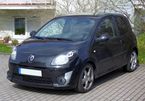 The Renault Twingo is a city car built by French automaker Renault, first presented at the Paris Motor Show in September 1992 and sold in continental European markets beginning in 1993. The second generation Twingo was launched in Summer 2007. The "Twingo" name is a portmanteau derived from the words "Twist", "Swing" and "Tango". ProjectThe Twingo was designed under Patrick le Quément, Renault's chief designer. Le Quément's belief was that it was a greater risk for Renault to take no risks at all, having seen its market share suffer from cars such as the Renault 9 and 11. The design of the Twingo resembles that of the 1982 Polish prototype Beskid (car), from which its monobox silhouette is claimed to be derived. |
Used Renault Twingo


ProductionThe Twingo has been built since its launch in France in 1992 and in Colombia and Uruguay from 1999 to 2002, undergoing three intermediate restylings in 1998, 2000 and 2004. Production of the first generation model ceased at the Flins factory in France on 28th June 2007. It is, however, still produced in Colombia by the Sofasa conglomerate for the South American market. Total production up to 30th June 2007 was 2,478,648. There were no right-hand drive first-generation Twingos built, and it was not sold in most RHD markets. CharacteristicsThe Twingo featured revolutionary features (at the time of launch) of a centrally-mounted instrument panel, consisting of a speedometer, fuel gauge and clock, with the odometer and trip recorder selected by pushing a button on the end of the steering column stalk. This left just a strip of warning lights in the area behind the steering wheel. It also had a sliding rear seat, which could be moved to either increase boot space or rear seat legroom. The boot parcel shelf was also unusual in that it was attached to the inside of the tailgate, and lifted up with the tailgate. It could also be clipped back against the rear window when not required. All the first-generation Twingos were equipped with straight-4 petrol engines. Initially available with an 8-valve 1.2-litre 55hp (41kW) engine, it was replaced with an 8-valve 1.1-litre 60hp (45kW) unit. A 16-valve 75hp (56kW) version was added in 2000. Many parts (e.g. the JB1 gearbox, brakes, engine) are shared with other vehicles across the Renault range. Electric versionA battery electric vehicle version was presented at the international Geneva Motor Show in 2006, that fits Zebra batteries. Timeline
» Read More About Renault Twingo |
Renault Twingo Pictures by Years


