Year of Opel Calibra
Opel Calibra photos, specs - Car Pictures & Images
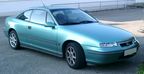 The Opel Calibra also known as the Chevrolet Calibra in South America, the Holden Calibra in Australia and New Zealand, and the Vauxhall Calibra in the United Kingdom is a sports car produced by German automaker Opel between 1989 and 1997. The Calibra was introduced to counter the Japanese sports coupes of the late-1980s and early-1990s, and is based around the running gear of the first-generation Opel Vectra, which had been launched in 1988. Calibra production was based in two Opel factories, Rüsselsheim in Germany and Uusikaupunki in Finland, where production was consolidated in November 1995. |
Used Opel Calibra


The Opel Calibra was styled by the US head of General Motors design Europe, Wayne Cherry. It is a front-wheel drive coupé, but because it is based on the Vectra chassis, its ride and handling are not significantly better than that of the large family car from which it grew. On its launch in 1989, the Calibra was the most aerodynamic production car in the world.[citation needed] This was glorified in an advert on British television during 1990. The eight valve model was, however, the most aerodynamically efficient Opel ever,[citation needed] with a drag coefficient (Cd) of 0.26. It remained the most aerodynamic mass production car for the next 10 years, until the Honda Insight and Audi A2 were launched in 1999 with a Cd of 0.25.[citation needed] All later 16V, V6, 4x4, turbo models had a worse Cd of 0.29 due to changes in cooling system, underbody, use of spoked wheels and glass detail. During its lifetime, the Calibra was much more popular in Europe than its nearest rival, the Ford Probe, which was considered to be underpowered and too American for most European drivers. However in the UK, it failed to outsell the Rover 200 Coupe which offered comparable performance at a lower cost and at the time Rover had a better image.[citation needed] In 1995, the Vectra A was replaced, but Calibra production proceeded until it was discontinued at the end of 1997. Although a smaller coupe (the Tigra) was available, the marque was left without a mid-sized coupé until the Astra Coupé was launched in 2000, and with the introduction of the Vauxhall VX220 in 2001, four years after the Calibra was discontinued, Opel finally offered a sports car again. Power was initially from 2.0 L 8-valve (85kW/ 115bhp C20NE) and 16-valve fuel-injected (110kW/ 150bhp C20XE) four-cylinder petrol engines. In 1992 a turbocharged 2.0 L engine (150kW/ 204bhp)(a C20LET, the turbocharged version of the C20XE) was added to the range. With four-wheel drive, a six-speed Getrag manual transmission (F28/ 6) and a claimed top speed of 240km/ h (149mph), this flagship model finally gave the Calibra the dynamics to match its looks. » Read More About Opel Calibra |
Opel Calibra Pictures by Years


