Year of Oldsmobile Aurora
The Aurora is powered by a 4.0-liter V-8 with 250 hp and a 4-speed automatic. ABS is standard.
Oldsmobile Aurora photos, specs - Car Pictures & Images
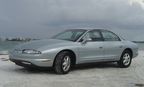 The Oldsmobile Aurora was a performance/ luxury sedan made by the Oldsmobile division of General Motors and launched in 1995. The Aurora rode on the same Cadillac-derived G platform as the 2-door Buick Riviera. With the demise of the Ninety-Eight in 1996, the Aurora became the flagship Oldsmobile. A V6-powered version was introduced in 2001 as supplanttation for the Eighty-Eight and the LSS. Since the 1980s GM had wanted a new car to bring new life to Oldsmobile, a car that was "not your father's Oldsmobile"; thus the Aurora was born, with several styling cues taken from the 1960s Oldsmobile Toronado. By the time the Aurora was released, Oldsmobile badly needed the Aurora, in hopes for a comeback of the marque (Oldsmobile sales had plummeted from 1,066,122 in 1985, to just 389,173 in 1992). As a symbol of its clean break from other cars in the lineup, the Aurora bore no Oldsmobile badging or script save for the cassette deck and engine cover. Instead, a new emblem consisting of a stylized 'A' was used, foreshadowing a similar restyling of Oldsmobile's corporate 'Rocket' emblem for 1997. |
With the Aurora, Oldsmobile tried to ride the praise of the car by launching other models that borrowed styling cues from the Aurora such as the Intrigue and Alero, as well as the redesigned Eighty-Eight, Silhouette, Cutlass, and Bravada. The Oldsmobile "rocket" logo was even updated to be more in-line with the Aurora's emblem. Because of this, a rumor started circulating at the time that the name of the whole Oldsmobile marque would be changed to simply "Aurora."[citation needed] Early design work on what would become the Aurora began as early as the late 1980s and manifested itself with a 1989 engineering concept known as the Oldsmobile Tube Car. Beyond the overall similar shape, the Tube Car featured many detailed elements that were later found on the production automobile, including a full-width taillamp, wraparound rear windshield, and frameless windows. Unlike the eventual production car, the Tube Car was of a pillarless hardtop design with suicide doors. After much research and development, the Aurora went into production on January 31, 1994, and was released for the 1995 model year. It hosted a number of luxury and technologically advanced standard features including dual-zone climate control, leather seating surfaces, burl walnut interior accents, and power adjustable front seats with 2-position memory. An onboard computer displaying the date, current gas consumption, and other information was standard. The Aurora also came standard with Oldsmobile's 4.0L L47 Aurora V8 engine, a DOHC engine based on Cadillac's 4.6L Northstar V8. The Northstar engine and 4T-80E had been exclusive to Cadillac prior to the Aurora. The Aurora had a drag coefficient of 0.32. The Aurora was highly regarded at the time for its refined engine, excellent build quality, well-balanced ride, and structural integrity. In fact, during normal crush-to-failure tests done by automakers to evaluate body rigidity, the Aurora's unibody construction actually broke GM's testing machine.[citation needed] A frame-crusher otherwise used to test stronger truck frames had to be used instead, with the car exceeding federal standards for passenger cars by two times. » Read More About Oldsmobile Aurora |
Oldsmobile Aurora Pictures by Years

