Year of Mitsubishi Jeep
Mitsubishi Jeep photos, specs - Car Pictures & Images
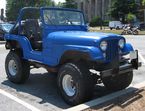 The Jeep CJ (or Civilian Jeep) is a public version of the famous Military Jeep from World War II. The first CJ prototype (the CJ-2) was introduced in 1944 by Willys, and the same basic vehicle stayed in production through seven variants and three corporate parents until 1986. A variant of the CJ is still in production today under license. The last CJs, the CJ-7 and CJ-8, were replaced in 1987 by the reworked Jeep Wrangler. Although it bore the CJ name, the CJ-2 was not really available at retail. The CJ-2s were merely prototypes used for testing purposes. Willys produced slightly more than three dozen CJ-2 Agrijeeps in 1944 and 1945, forty in all . It was directly based on the military Willys MB, using the same Willys Go Devil engine, but stripped of all military features, particularly the blackout lighting. Apart from having a side-mounted spare tire and an external fuel cap, the CJ-2 was the first jeep to feature a tailgate. Eleven CJ-2s are known to have survived to this day . |
Used Mitsubishi Jeep


Lessons learned with the CJ-2 led to the development of the first full-production CJ, the 1945-1949 CJ-2A. Like the CJ-2 and the military MB, the CJ-2A featured a split windshield. An early column shifter, which was introduced because it was thought that troops returning from WWII needed a change in the Jeep, and full floating rear axle gave way to the more familiar floor shifter and semi-floating rear axle. For CJ-2A production, the T-84 transmission was replaced with the beefier T-90 three speed transmission. It is of interest to note that many of the early CJ-2As were produced using surplus military Jeep parts such as engine blocks and, in a few cases, modified frames. Since the CJ-2A was intended to be used as a agricultural vehicle, it was geared lower than its military counterpart, and could be purchased with a variety of options such as a rear PTO and front counterweight. A total of 214,202 CJ-2A Jeeps were produced. The CJ-3A was introduced in 1949, and replaced the CJ-2A by the next year. It featured a one-piece windshield with a vent. A bare-bones Farm Jeep version was available starting in 1951 with a power takeoff. A total of 131,843 CJ-3As were produced before the series ended in 1953. Only one CJ-4 was ever built, as an experimental concept, in 1951. It used the new Willys Hurricane engine and had an 81-inch (2,057mm) wheelbase. The CJ-4 body tub design was a kind of intermediate between the straightforwardly raised hood on the CJ-3B and the all new curvy body style of the CJ-5. The design was rejected and the vehicle eventually sold to a factory employee. The CJ-3B replaced the CJ-3A in 1953, the same year Willys was sold to Kaiser. It introduced a higher grille and hood to clear the new Willys Hurricane engine. The CJ-3B was produced until 1968 with a total of 155,494 produced, although the design was licensed to a number of international manufacturers, including Mitsubishi of Japan and Mahindra of India. Mitsubishi ceased production of vehicles derived from the CJ-3B design in 1998, but Mahindra continues to produce Jeeps today. » Read More About Mitsubishi Jeep |
Mitsubishi Jeep Pictures by Years


