Year of Ford Econoline
The Econoline has the following array of engine options; 4.2-liter V-6 with 195 hp; 4.6-liter V-8 with 215 hp; a 5.4-liter V-8 with 235 hp; a 6.8-liter V-10 with 265 hp and a turbocharged and intercooled 7.3-liter diesel V-8 with 215 hp. All come standard with a 4-speed automatic transmission. This van sits up to 15 passengers.
Ford Econoline photos, specs - Car Pictures & Images
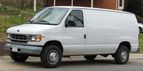 The Ford E-Series, formerly known as the "Econoline" or "Club Wagon", is a line of full-size vans (both cargo and passenger) and truck chassis from the Ford Motor Company. The E-Series is related to the Ford F-Series line of pickup trucks. The line was introduced in 1961 as a compact van and its descendants are still produced today. The Econoline is produced solely at Ford's Avon Lake, Ohio plant after the closure of the Lorain, Ohio plant in December 2005 and the consolidation of all production at Avon Lake. |
Used Ford Econoline


As of 2008, the E-Series is the only van in the Ford lineup in North America since the demise of the Freestar minivan in 2007. For the 2010 model year, Ford will return to having two vans as it gets the Ford Transit Connect compact MPV, which debuts at the 2008 Chicago Auto Show. The Ford E-Series currently hold 79.6% of the full-size van market in the United States with 168,722 sales in the United States in 2007. It has been the best selling American full-sized van for 28 years, since 1980. The first E-Series was based on the compact Ford Falcon, sized roughly to compete with the 1961 Chevrolet Corvair Sportvan and Volkswagen Type 2, which was 172.3in (4376mm) long. The first E-Series had a flat nose with the engine between and behind the front seats, later adopted by the Chevrolet Van and Dodge A100. Early models had a 144 cid 6-cylinder engine with a manual 3 speed transmission. Later models had a 170 CID or 240 CID engines with an automatic transmission. It was an immediate success with utilities like the Bell Telephone System. In the first 1961 model year, 29,932 standard vans, 6,571 custom Econoline buses, 11,893 standard pickups and 3,000 custom pickups were made. It was originally offered as a cargo van, an 8-passenger van with 3 rows of seats (which carried the Ford Falcon name) and as a pickup truck. A 165lb (75kg) weight was fitted over the rear wheels to balance the front-heavy vehicle, sometimes removed by current owners. The 1968 Ford E-Series revolutionized van design by moving the engine all the way to the front under a short hood. These would be the first vans used as the basis for the now popular Class C van cab motorhomes, a class still dominated by Ford. The 1968 E-Series also used Ford's "Twin I-Beam" front suspension design, and was now available with a V8 engine. Over the next six years, the "Big Three" (GM, Chrysler and Ford) would all redesign their vans, with hoods gradually evolving to a short conventional truck-like hood, and evolving from being based on compact cars to using components from full-sized pickup trucks. » Read More About Ford Econoline |
Ford Econoline Pictures by Years


