Year of Fiat Panda
Fiat Panda photos, specs - Car Pictures & Images
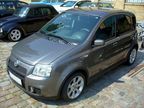 The Fiat Panda is a city car from the Italian automotive manufacturer Fiat. The first Fiat Panda was made from 1980 to 2003 with only few changes, and is now sometimes referred to as the "old Panda". The second model, launched in 2003, is sometimes referred to "new Panda" or "Nuova Panda" (in Italian), and was the European Car of the Year in 2004. Designed by Giorgetto Giugiaro, the Panda was designed as a modern day "peasant car": A cheap, basic, no-frills utility vehicle that would be easy to use and maintain. The car can be seen as a later approach to the same niche the Citroën 2CV or Renault 4 were designed to serve. Introduced in 1980, the Panda was noted for its box-like styling, which would become the house style for Fiats throughout the 1980s. Mechanically the first Pandas borrowed heavily from the Fiat parts bin. Engines and transmissions came from the Fiat 127 and, in certain territories, the air-cooled 652cc two-cylinder powerplant from the Fiat 126. The drive for a mechanically simple car was also evident in the rear suspension, which used a dead axle suspended on leaf springs. Later versions of the car added various mechanical improvements but this spirit of robust simplicity was adhered to throughout the life of the model. |
Used Fiat Panda


Many design features denote the Panda's "utility car" role. Examples include a 7-position adjustable rear seat which could be folded flat to make a bed, or folded into a V shape to support awkward loads, or easily and quickly removed altogether to increase the overall load space. The first Pandas also featured removable, washable seat covers, door trims and dashboard cover, and all the glass panels were flat making replacements easy and cheap to produce. Much like its earlier French counterparts the Panda could be specified with a full-length roll back canvas roof. The original Panda met with great success across Europe, polling 2nd in the European Car of the Year awards in its first full year of production (pipped to first place by the Mark III Ford Escort) and staying in production in some regions until May 2003. Mark I Original Panda: 1980-1986The first Pandas came fitted with either a two cylinder air-cooled 652 cc engine (derived from that in the 126)— the Panda 30; or a four cylinder water cooled engine displacing 903 cc (from the 127)— the Panda 45. Sized to fit between the 126 and 127 in Fiats product line-up, it was designed to be a practical affordable car, mechanically simple and robust. In September 1982 Fiat added more engines to the line-up. The Panda 34 used an 843 cc water-cooled unit derived from that in the 850. Fiat launched the Panda 45 Super at the Paris Motorshow later in 1982, with models of the old specification continuing as the "Comfort" trim. The Super offered numerous improvements, most significant being the availability of a five speed gearbox as well as improved trim. There were minor styling changes to the Super including the introduction of Fiat's new black plastic "corporate" grille with five diagonal silver bars. The earlier grille design (metal with slots on the left for ventilation) continued on the Comfort models until the next major revision of the line-up. A 30 Super was added to the range in February 1983, offering the Super trim but with the smaller engine. » Read More About Fiat Panda |
Fiat Panda Pictures by Years


