Year of Citroen C5
Citroen C5 photos, specs - Car Pictures & Images
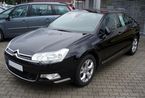 The Citroën C5 is a large family car produced by the French manufacturer Citroën since early 2000. The C5 replaced the Citroën Xantia in the large family car class. The first generation C5 was available as a five-door liftback or station wagon. Unlike its predecessors, the C5 was a liftback with a three-box design and a hatch. This form actually disguised the hatch, so Citroën has completely reversed the design philosophy from the fastback sedan era of Robert Opron. Power came from 1.8 and 2.0-litre straight-4 and 2.9-litre V6 petrol engines as well as 1.6, 2.0 and 2.2-litre direct injection diesel engines. |
Used Citroen C5


The first generation C5 was the last Citroën developed under the chairmanship of Jacques Calvet (1982-1999), a period which saw the marque's historically distinctive design and engineering brand erode markedly. The C5 had a further development of Citroën's hydropneumatic suspension, now called Hydractive 3. The major change with this system was the use of electronic sensors to replace the mechanical height correctors seen in all previous hydropneumatic cars. This allowed the suspension computer to automatically control ride height: at high speed the suspension is lowered to reduce drag and at low speeds on bumpy roads the ride height is raised. Manual control of ride height was retained, though it was overridden by the computer if the car was driven at an inappropriate speed for the selected height. Certain cars also featured the computer controlled ride stiffness seen on the Xantia and XM. In a major break with Citroën tradition, the brakes and steering were no longer powered by the same hydraulic system as the suspension. It has been speculated that the primary driver for this was the cost of developing electronic brake force distribution for the system when the PSA Group already had an implementation for conventional brakes. Another factor may be the highly responsive nature of Citroën C5 brakes, which some have found hard to adjust to on other hydropneumatic cars, though it is felt by some to be superior. It can be scary for a C5 driver used to the instant reactions of an older hydropneumatic car to drive another vehicle and find an inch of pedal travel before any significant braking is achieved. In 2004, the C5 underwent a major facelift (new front and rear ends; same centre section) to bring it into line with the look of the new Citroën C4. The liftback was lengthened from 4618mm (181.8in) to 4745mm (186.8in) and the station wagon from 4755mm (187.2in) to 4840mm (190.6in). Also this new version got swivelling directional headlights. The Hydractive suspension improves ride quality and keeps the car leveled and can enable the car to drive on three wheels if one tire is flat. The suspension is derived from the Hydropneumatic suspension used in the 1950’s Citroën DS. Variations in height using the Hydractive suspension range up to 15mm (0.6in) in the front and 11mm (0.4in) in the back. » Read More About Citroen C5 |
Citroen C5 Pictures by Years


