Year of Chevrolet Metro
The Metro is offered as a two-door coupe and four-door sedan. It comes with 2 engine options; 1.0-liter, 55-hp inline-three(that's right, 3 cylinders!) or upgrade to a 1.3-liter, 79-hp inline-four. Other options include a 3-speed automatic, a 5-speed manual, and optional ABS.
Chevrolet Metro photos, specs - Car Pictures & Images
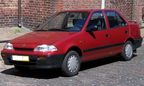 The Suzuki Cultus is a supermini first presented at the 25th Tokyo Motor Show, formally introduced to the Japanese domestic market in 1983 and ultimately manufactured in seven countries across three generations and marketed worldwide under more than a dozen nameplates — prominently as the Geo Metro and Suzuki Swift. Offered across its lifespan in four body-style variations with engines from the Suzuki G engine family, the Cultus remains in production both in China and Pakistan. |
The name Cultus derives from the Latin cultus, meaning "care" or "adoration." Generation IThe first generation of the Cultus was designed and developed by Suzuki for the Japanese Domestic Market (JDM) and introduced as the 1983 SA310, the name shortly thereafter changed to Cultus. After GM and Suzuki formed an alliance in 1981, GM imported the Cultus as a captive import, introducing it to the North American market as the 1985 Chevrolet/ Geo Sprint. Suzuki Cultus Generation I: 3= 3-dr hatchback 5= 5-dr hatchback a. Initially marketed as the SA-310 b. Also Hawaii, Guam, N. Marianas and test marketing USA 48 states. c. Canada's "Chevrolet" Sprint model ran through 1991 d. Manufactured at GM Colmotores, Bogotá, Colombia Generation IIThe second generation, introduced in 1989, had been designed at GM's Technical Center in Warren, Michigan, and was designated the GM M platform. Equipped with engines and drivetrains developed by Suzuki, The second generation offered new styling and four wheel independent strut suspension. The first European Generation II model was a "Suzuki Swift" manufactured in September 1992 in Esztergom, Hungary. Updates in 1996 followed, and model year 2000 modifications included a version fitted with a Suzuki 4 wheel drive system and badged as the Subaru Justy. The last modifications were made on the European Gen II from model year 2002 but only for the Hungarian market. The production of the 3-dr models ended in September 2002. In the same year, in December, the 4dr sedan version was also discontinued. The last variation was a 5dr version in March 2003. Generation II of the Cultus remains in production today in China and Pakistan. Suzuki Cultus Generation II, GM M platform: 2= 2-dr convertible 3= 3-dr hatchback 4= 4-dr sedan 5= 5-dr hatchback un = unknown a. Manufactured at Magyar Suzuki b. Imported to Colombia c. Geo branded models in US after 1989, in Canada after 1992 d. MF, MH: only generations of 'Cultus-derived' Barina e. Justy JMA/ MS, manufactured at Magyar Suzuki f. Manufactured at Paksuzuki » Read More About Chevrolet Metro |
Chevrolet Metro Pictures by Years
