Year of Audi S4
The Audi S4 comes stock with a 2.7-liter V6 biturbo engine which produces 250 hp. ABS is one of many standard features.
Audi S4 photos, specs - Car Pictures & Images
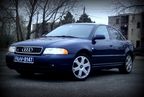 The Audi S4 name was originally used for the high performance sport version of the Audi 100 car and has subsequently been used for similar versions of the Audi A4 series. They are, or have been available as an "Avant", Audi's name for an estate car or station wagon, a saloon or sedan, and a Cabriolet (convertible) version. Like most Audi S cars, the S4 is only available with Audi's quattro four-wheel drive (4WD) system, with the S4 utilising the Torsen-based permanent "full-time" 4WD. The S4 has a larger more powerful engine, larger uprated brakes, and high-performance suspension systems which are not shared with the remainder of the A4 range. |
Used Audi S4


See also: Audi Ur-S4 / Ur-S6and Audi S6#C4
Audi was reconfiguring its model range during the early 1990s, and introduced the original S4 (Typ 4A) in 1992, as the performance version of the restyled Audi 100 (C4) saloon/ sedan. Despite being based on the Volkswagen Group C4 platform, and sharing its basic structure with the 100, the S4 effectively took the place of the Audi 200 quattro turbo, which had been discontinued the year before. Being the first S4 model from Audi, it is commonly referred to as the Ur-S4, derrived from the German augmentive word - Ursprünglich (meaning: original). Following Audi's decision in discontinuing the 100 nameplate, it re-badged the car as the Audi A6 in 1994, and the S4 became the S6, although the only real changes to the model were minor cosmetic updates, and the addition of a more powerful limited edition "S6 Plus" model using the V8 engine. After the first generation A6 was replaced in 1997 by an updated version based on C5 chassis, the S4 and S6 became distinctly separate from one another. C4 powertrainThe S4 was sold worldwide with a turbocharged version of Audi's 2.2litre (2226cc), 20-valve inline-5 engine developing 169kW (230PS; 227bhp) and 350N·m (258ft·lbf) of torque. Bosch Motronic engine control unit took care of all functions of the engine management. A 280PS (206kW; 276bhp) 4.2litre V8 engine became available to European customers as an option. Standard gearbox was a manual transmission (five and six-speed in Europe, five-speed only in North America), although a 4-speed automatic transmission was available as an option. Torsen-based (T-1) quattro permanent four-wheel drive was also standard. The most common configuration 2.2L 5-speed[citation needed] offered good acceleration for its day, achieving 100 km/ h (62 mph) in just 6.2 seconds. C4 brakes, wheels and tyresVentilated disc brakes were standard front and rear, with 10.9in (276.9mm) diameter discs up front, and 10.6in (269.2mm) diameter discs at the rear. Anti-lock braking system (ABS) was also standard. » Read More About Audi S4 |
Audi S4 Pictures by Years


