Year of Volvo 244
Volvo 244 photos, specs - Car Pictures & Images
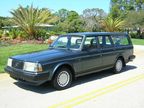 The Volvo 200 series was a range of mid-size cars produced by Volvo from 1974 to 1993, with more than 2.8 million sold worldwide. Also designed by Jan Wilsgaard, the 200 series replaced the 140 and 164, and overlapped production of the Volvo 700 series introduced in 1982. As the 240 remained popular, only the 260 was displaced by the 700 series — which Volvo marketed alongside the 240 for another decade. Ironically, the 700 series was replaced a year before the 240 was discontinued. |
The Volvo 240 was Volvo's best-selling car from 1975 until 1982.[citation needed] During those years in European markets, its companion was the smaller Volvo 66/ 300 series. The Volvo 240 and 260 Series was introduced in the autumn of 1974, and was initially available as six variations of the 240 Series (242L, 242DL, 244DL, 244GL, 245L and 245DL) and two variations of the 260 Series (264DL and 264GL). At a glance, the 240 and 260 Series looked much like the earlier 140 and 164 Series, but while they used many of the same components, and were largely the same from the passenger compartment back, they also incorporated many of the improvements used in the Volvo VESC ESV in 1972, which was a prototype experiment in car safety. The overall safety of the driver and passengers in the event of a crash was greatly improved with very large front and rear end crumple zones. The 200 Series had MacPherson strut type front suspension (which increased room around the engine bay) while the rear suspension was a modified version of that fitted to the 140 Series. The steering was greatly improved with the installation of rack-and-pinion steering, with power steering fitted as standard to the 244GL, 264DL and 264GL, and there were some modifications made to the braking system[citation needed]. The main changes were made to the engine. The 1974 240 series retained the B20A 4-cylinder engine from the 140 Series, with the new B21A engine available as an option on the 240 DL models. The new B21 engine was a 2127cc, 4-cylinder unit, which had a cast iron block, a five-bearing crankshaft, and a belt-driven overhead camshaft. This engine produced 97bhp (72kW) for the B21A carburettor 242DL, 244DL and 245DL, and 123bhp (92kW) for the B21E fuel-injected 244GL. All 240s were fuel injected in the US market; the carbureted B20 and B21 engines were not available due to emissions regulations. The 264 models had a completely new V6 B27E engine called the Douvrin engine. This engine was developed jointly by Peugeot, Renault and Volvo, and is therefore generally known as the "PRV engine"). The B27E engine had a displacement of 2664 cc, an aluminium alloy block, and wet cylinder liners. This engine produced 140bhp (100kW) for both the 264DL and 264GL. All models were available with a choice of 4-speed manual or 3-speed automatic transmission. Overdrive was also optional on the manual 244GL, while a 5-speed manual gearbox was optional on the 264GL and 265GL. » Read More About Volvo 244 |
Volvo 244 Pictures by Years
