Year of Subaru Leone
Subaru Leone photos, specs - Car Pictures & Images
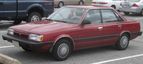 The Subaru Leone was a subcompact car produced by the Japanese car manufacturer Subaru from 1971 to 1994. The word "leone" is Italian for lion. It was released as a replacement to the Subaru 1000 and was in turn replaced by Subaru Impreza in the size class. All Leones were powered by the Subaru EA boxer engine. Most cars were equipped with optional four-wheel drive. Although released in Japan and some export markets as the Leone, in others (including at least the United Kingdom, Canada and United States), it was instead named with the trim level designation, which included: DL, GL, GLF, GL-10, and RX; sometimes the engine size would also form part of the name. This means the car is often referred to simply as the Subaru GL or the L-Series Subaru. |
Used Subaru Leone


With information translatted from the Japanese Wikipedia article. The first generation of the Leone was released October 7, 1971 as a front-wheel drive coupé, with trim levels DL, GL, and in Japan, the GS, and the GSR. April 1972 saw the introduction of the 2- and 4-door sedan with trim levels DL, GL and in Japan, the Super Touring. In September 1972, the four-wheel drive (4WD) station wagon was released, however it did not appear in the United States until 1974. Until then, four-wheel drive had been limited to mainly off-road vehicles for special use. Subaru broke that pattern by introducing a mass-produced four-wheel drive passenger car. Throughout the years, the Leone would see the introduction of a two-door hardtop, a four-door sedan, and a four-wheel drive station wagon. In August 1968, Subaru entered into an alliance with Nissan Motors, and the appearance of the new Leone was influenced by design efforts from Nissan, most notably the long hood and short trunk appearance that Nissan was using at the time for their products. The Japan-spec 1400 GSR was one of the first Japanese automobiles to use 4 wheel disc brakes. The 2-door hardtop was introduced June 1973. The first-generation Leones were equipped with either a 1.4 L or 1.6 L, flat-4, carbureted, OHV engine. They were available with a 4-speed manual transmission, 5-speed manual transmission or a 3-speed automatic transmission beginning in 1975. Some early models had drum brakes in the front, however later they were all equipped with disc brakes in the front. All models had rear drum brakes. Unusually the handbrake or emergency brake operated on the front wheels. The Leone was first brought to the United States of America in 1972. The 4WD station wagon did not make it to the U.S. until 1974, released as a 1975 model. In 1976 the EA63 engine was replaced with the EA71 engine, which was optional the year before in the GF hardtop. In April 1977 an updated Leone range was released. All body panels were altered slightly and a completely new dashboard was fitted. Despite these changes, however, the overall effect was much the same as the earlier version and virtually mechanically identical. » Read More About Subaru Leone |
Subaru Leone Pictures by Years


