Year of Renault Scenic
Renault Scenic photos, specs - Car Pictures & Images
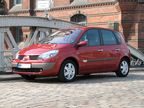 The Renault Scénic is a compact MPV produced by French automaker Renault, the first to be labelled as such in Europe. It is based on the chassis of the Mégane small family car. It became European Car of the Year on its launch in late 1996. The Megane Scénic can be traced back to a concept car designed under the supervision of Anne Asensio, then Head of Design at Renault. The Scénic was mechanically identical to the Mégane hatchback (itself based on the older R19). The 1.4L, 1.6L "Energy", 1.8L "F-type" petrol and 1.9L diesel engines were shared with the hatchback range. The Scénic was aimed at those who wanted all the practicality of a multi-purpose vehicle, but could not accommodate the larger size and higher price of such vehicles as Renault's own Espace. Renault underestimated the sales impact that the Scénic would have — predicting that it would be a niche model with only 450 produced a day. Production at the company's Douai plant would eventually peak at nearly 2500 cars a day. With the Scénic, Renault created a new market segment — the compact MPV, and the concept was quickly imitated by other manufacturers. |
Used Renault Scenic


Phase 2 (1999)Along with the Mégane hatchback, the Scénic underwent a minor frontal restyle in 1999 and the newer 16-valve engines introduced. From the time of this restyle, it became officially known as the Renault Scénic, although a small "Mégane" badge still appeared on the rear door signifying the car's origin. This model is still built in Brazil with flexible fuel engines. Scénic RX4Renault developed a four-wheel drive derivative of the original Scénic, the Scénic RX4. Featuring a viscous, multi-disc central differential designed by Austrian specialists Steyr Daimler Puch, it offered part-time 4WD. Renault also fully re-engineered the rear suspension and strengthened the front. The redesigned rear suspension occupied the space required for the spare wheel well and led to the spare wheel being placed on the rear hatch. The RX4 rode higher with increased suspension travel and larger wheels. While these changes provided a rugged chassis, the RX4 was held back by a single range transmission and an engine, the 2.0 litre from the Mégane, with limited low-end torque. Production of the RX4 ceased in 2003, and no replacement was expected until the sudden arrival of the Scénic Conquest in 2007. Shortly after the launch of the Mégane II, an all-new Scénic was launched. There is also a seven-seater Compact MPV Grand Scénic, with a longer wheelbase and rear overhang, which has two small child-sized seats in the enlarged luggage area. As with the Mégane, the new car employs Renault's new corporate styling cues and much of the technology from other models such as the "Renault Card" keyless immobiliser and an automatic parking brake on certain trim levels. It integrates LEDs on all trims since 2006. As with Scénic I Phase 2, a raised "Mégane" logo appears on the C-pillar in tribute of the car's origin. Scénics includes folding front passenger seat with integrated table, automatic headlights and windscreen wipers, 'Child minder' mirror and front and rear electric windows. » Read More About Renault Scenic |
Renault Scenic Pictures by Years


