Year of Nissan Maxima
The Maxima is offered as a 4 door sedan with a 3.0-liter/190-hp DOHC V-6 with a 5-speed manual or a 4-speed automatic. ABS is optional.
Nissan Maxima photos, specs - Car Pictures & Images
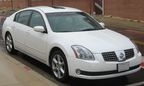 The Nissan Maxima is a Full-size car (formerly mid-size) manufactured by Nissan that is sold in the United States and Canada. The Maxima debuted in 1976 as an upscale version of the Bluebird and was spun into its own line in 1980, having been made continuously since then. Most pre-2004 Maximas were built in Oppama, Japan, until the current North American Maximas started being assembled in Smyrna, Tennessee. The Maxima models are also known as Nissan Cefiro or Nissan Laurel in various markets. The US-spec Maxima shares the FF-L and D platforms with the Nissan Altima and Nissan Teana; the Teana is often exported as the Nissan Cefiro or Nissan Maxima to other markets (not to be confused with the US-spec Maxima). |
Used Nissan Maxima


The Maxima model line began with the Nissan Bluebird Maxima, which was available in the US as Datsun 810 from February 1977. It was powered by two versions of the SOHC L-series I6 engine, a 2.0L displacement for the Japanese market and a 2.4L (as found in the Datsun 240Z) for the US market. The Bluebird Maxima used a carburetor for the base model and fuel injection for the sporty version. The 2.0L engine was good for 122PS JIS (90kW), while the bigger American engine could reach 125hp SAE (93kW). The sporty version channeled power through a five speed manual transmission. These cars were rear-wheel drive and had a semi-trailing arm rear suspension. The station wagon variant had the rear live axle for load carrying reasons. The 2-door coupe version was introduced in 1979 along with an exterior refresh, and was available in the Maxima lineup in the Datsun 810 only. The new Datsun 280ZX shared the 810's chassis, though the 810 did not get that car's larger 2.8L engine. The first car to wear the Maxima name was introduced in 1981. It was essentially a Japanese-market Bluebird 910 with a 3.9in (99mm) longer nose. The car was offered as the 810 Deluxe or 810 Maxima that first year, and all 810s became Maximas for 1982. In 1984, the last year of the first generation Maxima, American Datsuns began carrying the "Nissan" badge as well (only 1984 Nissans have both "Nissan" and "Datsun" on the back of the car). Toyota responded to the introduction of the Maxima with the Japanese market Toyota Mark II and named the car the Toyota Cressida. Powered by the same 2.4L I6 engine as the previous Datsun 810 and Datsun 240Z, the car was still rear-wheel drive. It was also available with the LD28 OHC 2.8L I6 Diesel engine (available in the US from mid-1981 through 1983) with either 5 speed manual or automatic transmission. Some of the power steering pumps were sourced from General Motors' Saginaw Gear division, while others were sources from Atsugi. This was the second Nissan to use US-sourced parts besides the Borg-Warner T-5 transmission used in the 82-89 Nissan ZX Turbo's. » Read More About Nissan Maxima |
Nissan Maxima Pictures by Years


