Year of Mitsubishi Diamante
The Diamante is offered as a four door sedan with a 3.5-liter/210-hp SOHC V-6. It comes standard with a 4-speed automatic and ABS is optional.
Mitsubishi Diamante photos, specs - Car Pictures & Images
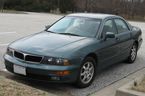 The Mitsubishi Diamante was first introduced to the public at the Tokyo Motor Show in 1989, and went on sale in Japan in May 1990. It became the second generation Magna, replacing the widened 1983 Galant Sigma manufactured and sold in Australia as a Mitsubishi Verada (the 1987 Galant was downsized, thus leaving a gap in the product range for the Diamante). There have been rumors that the Diamante was either not intended for a Japanese launch, or it might have been planned as a low-volume model. The reason for this argument is that until 1989, the width of vehicles was a vital indication of taxation class. The Diamante, being wider than the 1700 mm break, would have suffered a large tax penalty against most of its rivals, which were designed to be just under limit. At the time, Mitsubishi's image was also considered less than ideal for the marketing of a luxury car—its most expensive offering that the time, the Debonair, was largely seen as a company car project for Mitsubishi conglomerate executives. |
Used Mitsubishi Diamante


However, the tax situation had changed in 1989, and the Diamante became the surprise hit of 1990. Amidst Japan's bubble economy, many private car owners sought an executive car in a market that had very few new offerings that year. The Japanese market Diamante was a four-door hardtop with no window sashes. Five months after the Diamante's launch, Mitsubishi also introduced the Sigma, which was different from the Diamante in a slightly taller roofline, side window graphics, window sashes, and front/ rear treatment. In Japan, the Diamante was available with three V6 engines (2.0, 2.5 and 3.0 Liter) of the 6G7 family; all wheel drive was available on most models. Perhaps contrary to its overseas image, Mitsubishi at the time fully emphasized the use of electronic gadgets in its cars, and the Diamante is notable for a long list of such features. This generation won the Japan Car of the Year award in 1990. The Diamante was first sold in 1992 in the United States, replacing the Sigma, which was based on previous generation Mitsubishi Galants. In Australia, Magna station wagons had been sold there since the 1980s; like that car, a station wagon based on the Diamante/ Sigma was exported back into Japan. The First Generation Diamante is equivalent to the second generation Magna and Verada. The first generation Diamante is the car upon which the second generation Magna/ Verada is based. The first generation Diamante came in three versions: Four-side window sedan: Unlike the Magna/ Verada this Diamante did not have the rear quarter windows. The only side glass was that in the doors. All of these vehicles were built in Nagoya in Japan and were intended for the Japanese domestic market. Six-side window sedan: Much the same as the Second Generation Magna/ Verada. Built in Australia. Wagon: Introduced in 1993, again the same as Magna/ Verada and built in Australia. Japanese specThe Japanese spec Diamante was built from 1990 until 1995 and was available in front and all-wheel drive. » Read More About Mitsubishi Diamante |
Mitsubishi Diamante Pictures by Years


