Year of Mercedes-Benz A140
Mercedes-Benz A140 photos, specs - Car Pictures & Images
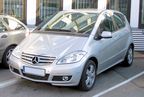 The Mercedes-Benz A-Class is a compact car produced by the German automaker Mercedes-Benz. The first generation (W168) was introduced in 1997 and a redesign (W169) appeared in 2004. It is available as a three or five-door hatchback. It is Mercedes' entry level model in most of its worldwide markets, though not in North America; the B-Class is the entry model in Canada and Mexico, and the C-Class is the entry model in the US. It's main rivals are the Audi A3 and BMW 1-series. |
W168Production of the W168 A-Class began in 1997. It was also the first front wheel drive passenger car from Mercedes-Benz. Its front engine, front wheel drive layout was quite unusual for Mercedes. To date, about 1.6 million units have been sold worldwide. One innovation of the W168 was a frontal-impact absorption system called the "Sandwich" (see patents DE4326 9 and DE4400132 in the name of Mercedes-Benz). In the event of a violent frontal impact, the engine and transmission would slide underneath the floor below the pedals rather than entering the passenger compartment. The W168 became infamous in 1997 after flipping over during the traditional "moose test" performed by the Swedish automobile publication Teknikens Värld. According to the report, the W168 overturned when maneuvering to avoid the "moose". Mercedes initially denied the problem, but then took the surprising step of recalling all units sold to date (2,600) and suspending distribution until the problem was solved by adding electronic stability control and modifying the suspension. This marked the world première of stability control in a small car. W168Driving assistanceThe car is designed according to Mercedes-Benz concept of 'Touch And Feel' (TAF). The multi-function steering wheel places controls for the radio, telephone, and other systems conveniently within reach of the thumbs of the driver. Power steering (standard feature) aids control of the automobile, with its behaviour varying according to the vehicle's speed. The Mercedes COMAND APS is a navigation system which provides directions via GPS. The radio unit also provides DVD and telephone functionality, with various versions available (standard Audio 20 radio/ single CD, Audio 50 APS or COMAND APS). The Parktronic system provides audio and visual signals to indicate how far the car is from an obstacle. The A-class optionally includes a "Light & Sight" package which includes bi-xenon HID headlamps with gas-discharge bulbs; cornering lights (main-beam headlamps at road junctions and tight corners); "Headlamp Assist, which automatically turns on the lights when needed; and a rain sensor that adjusts wiper speed depending on rainfall intensity. » Read More About Mercedes-Benz A140 |
Mercedes-Benz A140 Pictures by Years


