Year of Jeep Wrangler
The Wrangler, Jeep's original off-roader, comes standard with 4 wheel drive. Choose between the 2.5-liter pushrod 8-valve 4-in-line with 120 hp or the 4.0-liter pushrod 12-valve 6-in-line with 181 hp and a 5-speed manual or 3-speed automatic transmission.
Jeep Wrangler photos, specs - Car Pictures & Images
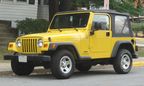 The Wrangler (also known as the YJ, TJ, and JK, as explained below) is an SUV produced by American automaker Chrysler under its Jeep marque. It is a successor to the famous World War II 'Jeep' vehicle by way of the Willys civilian Jeep (CJ) in the 1950s, later produced by Kaiser-Jeep and by American Motors (AMC). The Wrangler debuted in 1987, was updated in 1997 and again in 2007, and is still popular today. From 1987 until 1992 the Wrangler/ YJ was built in Brampton, Ontario, Canada. It was then built in the Toledo South Assembly plant until mid-2006, after which the plant was slowly torn down. The Wrangler is currently produced at Jeep's Toledo North Assembly plant in Toledo, Ohio. |
Used Jeep Wrangler


The Wrangler name was not used in Canada, as it was a trim level of Chevrolet pickup in that market. Instead, 1987 to 1995 models were sold as YJ, and 1997 to 2006 models were sold as TJ. The model designations of YJ and TJ are used throughout the world in the Jeep enthusiast community to differentiate which model is being spoken of instead of using the more ambiguous term "Wrangler". The Jeep YJ, sold as the Wrangler, replaced the much-loved but slower-selling Jeep CJ in 1987 and was built in Brampton, Ontario, Canada until the plant closed on April 23, 1992. It was a new design with a wider wheelbase, slightly less ground clearance, a galvanized body and more comfort. The YJ also had a leaf spring suspension similar to that of the CJ, however, the springs were wider, and the YJs sported trackbars and swaybars for added handling. YJs are easily identifiable by their rectangular headlights, which were a source of controversy when introduced. Despite the new grill, the body is very similar to the CJ7's, and it is interchangeable with some minor modifications. The YJ also was given a larger windshield over the CJ. 632,231 YJs were built through model year 1995, though YJs were still produced into mid '96 bringing the total production number to 685,071 units. The YJ used a 2.5L AMC 150 I4 or optional 4.2L AMC 258 I6 until 1991. That year, a fuel injected 180hp (134kW) 4.0L AMC 242 variant replaced the 112hp (84kW) 4.2L 258CID straight-6. The NP207 transfer case was used only in 1987 and replaced by the NP231 The roll cage was extended in 1992 to allow for rear shoulder belts, and anti-lock brakes were added as an option the next year. An automatic transmission option for 4-cylinder Wranglers came in 1994 along with a center high-mounted stop light. In 1994, the slave cylinder on manual transmissions was moved outside of the transmission's bellhousing to allow for easier replacement, and in 1995 larger U-joints were used [front axle U-joints(297x) and rear pinion U-joint(1330)]. For the 1992 model year, the YJ switched over to an electronic speedometer outmoding the cable speedos on older YJs. 1995 was the only year to have a fully galvanized frame and body. » Read More About Jeep Wrangler |
Jeep Wrangler Pictures by Years


