Year of Ford Crown Victoria
The Crown Victoria is offered as a four-door sedan with a 4.6-liter V-8 with 190 hp(optional 210 hp setup available). A 4-speed automatic is standard and ABS is optional.
Ford Crown Victoria photos, specs - Car Pictures & Images
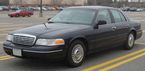
For the Police Interceptor version used by law enforcement, see Ford Crown Victoria Police Interceptor. For the 1979–1991 version known as the LTD Crown Victoria, see Ford LTD Crown Victoria.
The Ford Crown Victoria is a rear-wheel drive full-size car first produced by the Ford Motor Company for the North American market in the mid-1950s. The name was introduced again in 1983 when the Granada was discontinued and renamed LTD. For many years, the full-size car has fallen out of favor, and Ford has been left with a near-monopoly as a result. In 1974, American Motors discontinued the Ambassador; Chrysler discontinued the R platform full-size cars in 1981 and the M platform in 1989. In 1996, General Motors pulled the Chevrolet Caprice and Impala SS off the market, leaving its Lincoln-Mercury stablemates as its only competitors. |
The 5,424 Crown Victorias sold in January 2007 far exceeded the 3,526 of the newer Ford Five Hundred which is a more technically advanced full size car with similar passenger space and better fuel economy. But while newer front-wheel drive platforms may have been popular among consumers, they have not challenged the Crown Victoria's dominance as a taxi cab, fleet vehicle and police car where durability, cost and performance rather than efficiency are top requirements. A longer wheelbase version is available for taxi use. Retail sales dwindled to just 3,000 in 2006, compared to 38,280 of its stablemate Mercury Grand Marquis in the first nine months of 2007. Following its withdrawal from Canadian retail dealers, the Crown Victoria has been limited in the US market since the 2008 model year to fleet sales, which constituted 95% of its total sales in recent years. The Mercury Grand Marquis, as well as the platform-sharing Lincoln Town Car, will continue to be available to retail consumers. As the latest evolution of the traditional rear-drive full-sized Ford (as the Crown Victoria traces its ancestry to the original 1932 Model 18 V8), it is the end of the longest succession of automobiles starting with the Model T. The "Crown Vic" is popular due to its conventional rear-wheel drive, V8 power, popular with police driving techniques. As one of the few remaining passenger cars with body-on-frame construction, it is rugged, and enables repairs after minor accidents without the need to straighten the chassis - an important benefit for a car frequently used by police forces for PIT maneuvers; ramming a car to spin it out. The Crown Victoria is also one of the few remaining automobiles which retains the traditional 2-bench 6 passenger seating layout, which has otherwise largely been replaced by the two front-bucket layout popularized by imports. While the Crown Victoria shares its platform and components with the Lincoln Town Car, it shares almost no exterior sheet metal or interior parts. The current model has had a number of upgrades. Since the exit of General Motors from rear-drive full-size cars with the Chevrolet Caprice, it held a near-monopoly as a pursuit vehicle in North America, despite front wheel drive offerings such as the Chevrolet Impala. However, the Dodge Charger has started to challenge this dominance with some significant adoptions among police and taxi fleets since its introduction. While there has been speculation of replacements, some based on the slightly smaller Australian Falcon, no firm plans have been announced by Ford, however the similar Grand Marquis has since been replaced by the Ford Taurus as the sole full size offering in Canada. » Read More About Ford Crown Victoria |
Ford Crown Victoria Pictures by Years
