Year of Fiat Uno
Fiat Uno photos, specs - Car Pictures & Images
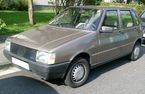 The Fiat Uno is a supermini car produced by the Italian manufacturer Fiat. The Uno was launched in 1983 and built in its homeland until 1995, with production still taking place in other countries. The Uno was launched to replace the ageing Fiat 127. Designed by Giorgetto Giugiaro's ItalDesign company, its tall, square body and a low drag coefficient of 0.34 won it much praise for airy interior space and fuel economy. It incorporated many packaging lessons learnt from Giugiaro's 1978 Lancia Megagamma concept car (an experimental MPV) but miniaturised. It was voted European Car of the Year in 1984. |
Initially, the Uno was offered with the 0.9litre (903cc) OHV, 1.1litre (1116cc), and 1.3litre (1301cc) 138-series SOHC petrol engines.The 1.3 (1300cc) diesel (not for the UK market) engine was launched a couple of months later. The Uno's badging was not by the commonly used measurement of engine size but by bhp: 45, 55, 60, 75 or 90. The Uno was available as either a 3- or 5-door hatchback. It also featured unusual "pod" switchgear cluster around the main instrument binnacle, although indicators remained on a stalk; an unusual arrangement notably also used by Citroen. The Uno had MacPherson strut independent front suspension and beam axle rear suspension with telescopic dampers and coil springs. From 1985, the new 1.0litre (999cc) SOHC Fully Integrated Robotised Engine (FIRE) powerplant was offered. This was a lighter engine and gave improved performance and economy. Also in 1985, the hot hatch version - Uno Turbo - was launched, with an IHI turbocharged Ritmo/ Strada-derived 1.3 146-series engine, initially offering 105bhp (78kW). It was priced to compete with the Peugeot 205 GTI. In 1987, a 1.7litre diesel engined version - the 60DS -was launched. Also in 1987, the Uno Selecta continuously variable transmission (CVT) automatic was launched. This was a co-development with Ford of the Dutch Van Doorne gearbox as used by DAF and later, Volvo. In September 1989, the Uno was given a major facelift, which saw updated bodywork at the nose and a different tailgate, that improved the drag coefficient to Cd0.30. The interior was also revised. The pod switchgear was replaced by stalks and an effort was made to stop the dashboard rattles of the Mark I. At this time, the old 1.1litre engine was replaced by a new FIRE version, and a new Fiat Tipo-derived 1.4litre engine replaced the Ritmo/ Strada-derived 1.3litre in both naturally aspirated and turbo versions. The Uno Turbo i.e. variant was also restyled, upgraded with a Garret T2 turbine, Bosch LH Jetronic fuel injection and better aerodynamics. » Read More About Fiat Uno |
Fiat Uno Pictures by Years


