Year of Dodge Durango
Dodge's all popular sport utility is now available with 3 engine choices; the new 3.9-liter pushrod 12-valve V-6 with 175 hp a 5.2-liter pushrod 16-valve V-8 with 230 hp or the 5.9-liter pushrod 16-valve V-8 with 245 hp all with a 4-speed automatic transmissions.It can sit up to 8 with the optional 3rd row seat.
Dodge Durango photos, specs - Car Pictures & Images
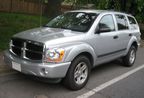 The Dodge Durango is a full-size SUV from Chrysler's Dodge brand. It was introduced in 1998 as a mid-size SUV, and as a replacement for the Ramcharger discontinued in the North American market in 1993, and was redesigned for 2004. The Durango was produced at the Newark Assembly plant in Newark, Delaware until the end of 2008. The Durango was launched just after the second generation Dodge Dakota on which it was based. During the late 1980s, Chrysler designers had proposed building an SUV version of the Dakota pickup[citation needed], but this was shelved when the Jeep division was about to release the Jeep Grand Cherokee as their flagship SUV. The Durango was marketed as a sturdy truck-based SUV designed to hold up to seven passengers and tow up to 6,700lb (3,039kg). The 4.7L PowerTech V8 replaced the 5.2L engine for 2000. In that same year a special all wheel drive performance version called the R/ T was released with a 5.9L V8 engine. |
Used Dodge Durango


2001 saw a few revisions, including a redesigned interior, including a new dash, door panels, and revised seats. Other minor changes redesigned aluminium wheels, and minor changes to trim options. Trim levels
Engines
2004–2006The second generation Durango debuted shortly before the companion Dakota. Like the Dakota, it has much in common with the large Dodge Ram pickup, including a fully-boxed frame. And like the first generation model, its front grille resembles the Dakota's. It is 7in (177.8mm). longer, 2in (50.8mm). wider, and 3in (76.2mm). taller than the previous model. For this model year, it offered a full third row with three seats, making the Durango an 8 Passenger SUV. The design has also has taken styling cues from the Dodge Powerbox concept as the design look similar except that the front fascia is more normal while the Powerbox had a different look. Chrysler introduced its own version of the Durango, the Chrysler Aspen, for the 2007 model year. The Durango became nearly a full-size SUV this time — although technically it is still classified as mid-size, and the upcoming Dodge Journey on the Avenger platform filled Dodge's mid-size SUV gap as a 2009 model. 2007–2009The 2007 model was reworked to halt a sales decline, debuting at the Dallas Auto Show in April 2006. It includes a reworked front clip with a new fascia, grille, hood, and headlamps as well as updated fenders and wheels. New features include electronic stability program, tire pressure monitoring system, rear park assist, and a one-touch turn signal. The 2007 model also has a reworked floor, third-row seats, and electrical system in preparation for the 2009 hybrid version. » Read More About Dodge Durango |
Dodge Durango Pictures by Years


