Year of Daihatsu Storia
Daihatsu Storia photos, specs - Car Pictures & Images
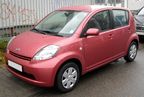 The Daihatsu Sirion is a subcompact car produced by the Japanese automaker Daihatsu since 1998 and marketed variously as the Daihatsu Storia , Daihatsu Boon, Toyota Duet and Toyota Passo. The Sirion was launched in 1998 and has since undergone two upgrades, one in 2001 and another in 2004/ 2005. The version of the Sirion on sale in Europe and Australia in 2005 was first released in Japan in June 2004 under the names Daihatsu Boon and Toyota Passo. The 1998 incarnation of the Sirion came with two petrol engines (with multi-point fuel injection): a 1.0 litre 3-cylinder with 54bhp (40kW), and a 1.3 litre 4-cylinder 86bhp (64kW) unit (shared with the Toyota Yaris). Both were available with either a 5-speed manual or an automatic gearbox. As of 2001, 1.3L models have 102bhp (76kW) engines capable of accelerating from 0-60 mph in 9.6 seconds and reaching a top speed of 111mph (179km/ h). This engine is very fuel efficient with an average rating of 49.6 mpg[vague] and the 1.0 model averaging 51.4 mpg. |
Used Daihatsu Storia


There are two Rally versions of the Sirion: the Rally 2 and the Rally 4; the latter being the four-wheel drive version. The Rally models have a slightly increased engine output of 108bhp (81kW) and boast a class-leading 0-60 time of 8.1 seconds and reaching a top speed of 115mph (185km/ h), giving it 'hot hatch' credibility. The 4Track (or just 4WD in Europe) is the four-wheel drive version of the standard 1.3. The F-Speed model is equipped with Formula-1 style paddle gear changers. The Australian market only had the 1.0 litre model up until early 2001, when the sporty 1.3 litre model - known as the GTvi - was added to the line-up. At the time, the GTvi had the most powerful naturally aspirated motor available in its class, developing 101 bhp (75 kW) at 7500 rpm. This version was also known as the Toyota Duet. In 2001, the Sirion was slightly restyled; the front grille was changed to look more sporty and in some markets the silver accents on the sides were removed. The dash was redesigned, incorporating more storage space and easier to use controls. The second generation of the Daihatsu Sirion received a complete makeover and looks markedly different from the first model. A 1.5 L engine is available in some oversea market such in Singapore or UK. For Japanese Domestic Market, the car sold as Daihatsu Boon and Toyota Passo available with 1.0 L and 1.3 L engine. The major difference between the JDM's Sirion are automatic version where the gear-changing located beside the steering on the dashboard and the handbrake below the steering. As usual the JDM car will have both front-wheel drive and four-wheel drive version. A 1.0 L turbo version with 4WD also available know as Boon X4. This Sirion was designed for European tastes, and the model took on a larger and stockier frame. It weighs about 940kg (2072lb). Boasting a remarkable amount of interior space, split-folding rear seats, numerous safety features and impressive fuel economy, the Sirion found its niche as a small-family compact car. » Read More About Daihatsu Storia |
Daihatsu Storia Pictures by Years


